
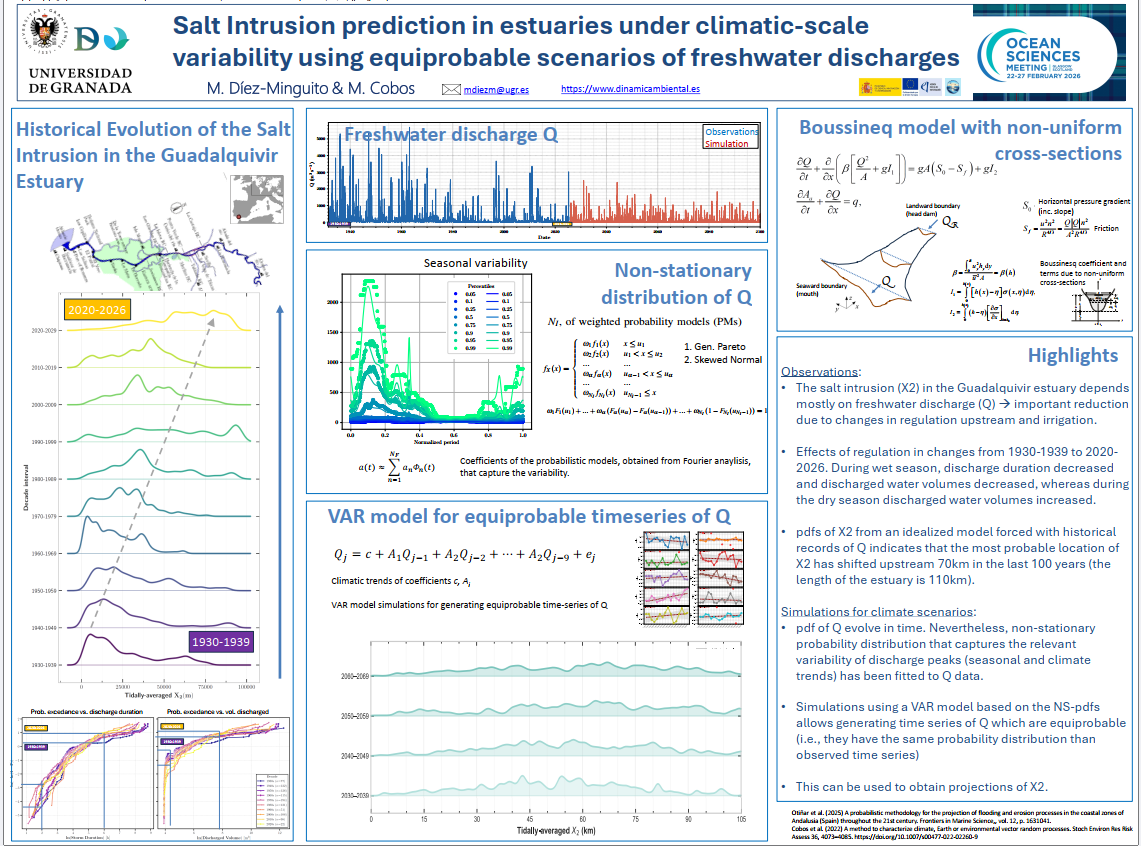
Manuel Díez‑Minguito participated in the Ocean Sciences Meeting 2026 in Glasgow, presenting recent advances on the prediction of salt intrusion in estuaries under climate‑scale variability. The contribution focused on a novel statistical–dynamical framework to estimate the salinity intrusion reference point X2 using equiprobable, non‑stationary freshwater discharge scenarios.
The study applies this methodology to the Guadalquivir Estuary (Spain), a well‑mixed and strongly regulated system where freshwater releases play a key role in controlling salinity. Using an idealized cross‑sectionally averaged model, the team conducted a 100‑year hindcast simulation, revealing a bimodal probability distribution of X2: one mode associated with typical low‑flow conditions, and a second mode linked to high‑flow events that temporarily shift X2 seaward.
Results show that dam operations, particularly impulsive releases, exert a strong influence on the distribution of X2. A clear non‑stationary trend emerges over the century‑long simulation, with X2 gradually shifting upstream as freshwater availability declines.
To explore future conditions, the team generated synthetic river‑flow time series using a combination of non‑stationary probability distribution fitting and vector autoregressive modelling, producing equiprobable discharge scenarios consistent with projected climate trends. These series enabled climate‑scale projections of X2 up to the year 2100, capturing long‑term tendencies and uncertainty in freshwater inputs.
This work provides a robust framework for anticipating salinity intrusion under changing hydrological regimes